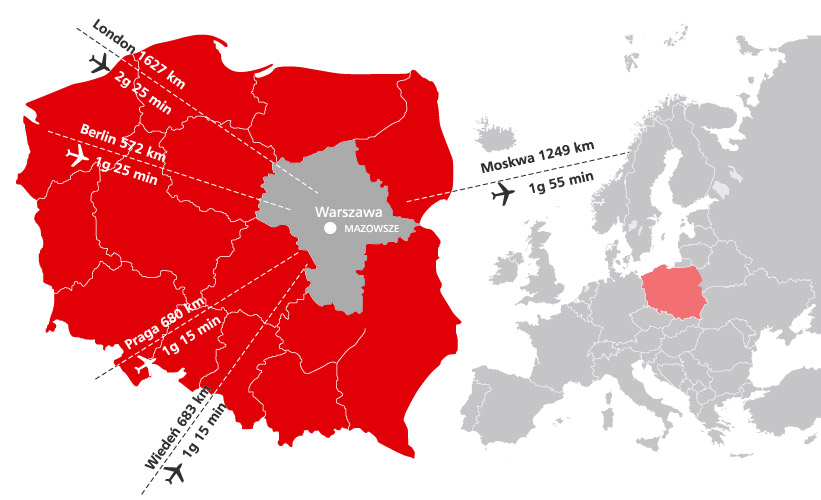
MAZOVIA
Area of the Masovian Voivodeship – 35,559 km²
Number of inhabitants of Mazovia – 5.51 million
Capital – Warsaw
WARSAW
Area of Warsaw – 517 km²
Number of inhabitants of Warsaw – 1.86 million
Mazovia, with Warsaw located at the heart of the voivodeship, is the region where the largest number of films are made in Poland – it is here that the film, services, and audiovisual production markets have developed the most.
Mazovia owes its uniqueness on a European scale to its location – the modern capital of Poland is located in an area of great economic and ecological potential, where you can find abundant green spaces and untouched Polish nature. The areas around Mazovia’s cities and towns are rich in exceptionally picturesque locations. This allows film crews to establish a convenient base in Warsaw, either permanently or temporarily, and easily travel throughout the region, with local landscapes no more than a two-hour drive from the capital.
Winding, wild river bends, nurseries, natural flora and fauna, gentle hills bordering the plains, hundreds of kilometers of fruit orchards, soaring church spires in the cities – these are the most characteristic features of the Masovian landscape, exceptionally friendly to film crews.
Over 5.5 million people live in Mazovia, with the largest population naturally in Warsaw. The capital city is home to nearly 2-2.5 million people, depending on whether one counts only Warsaw residents registered or those working in the capital. Besides Warsaw, the region also includes four medium-sized cities – Radom, Płock, Ostrołęka, and Siedlce. Unusually for a central district, 30% of Mazovia is protected green areas, 20% of which are forests.
This means film crews don’t have to leave Mazovia to find interesting urban, historical, and modern locations hidden away in local towns. Warsaw, a city of a thousand contrasts, rebuilt after the devastating devastation of war, is currently the most popular filming location in Poland.
Architectural gems – the Old Town and the Royal Route – border the gray-green Powiśle district, numerous city parks, and green spaces. Right next to it, a mosaic of exemplary examples of socialist realism from the 1950s sits in the very center of Warsaw, juxtaposed with the largest concentration of Polish modern architecture. However, one need only cross the Vistula River to see industrial and post-industrial districts and buildings, often finding their place in contemporary cinema.
Beautiful, historic buildings can be found in Płock – proudly perched on Tumski Hill – and in Radom, a developing industry and open to film crews, where long streets lined with clean, 19th-century buildings have been preserved. The Masovian cities and towns, densely scattered throughout the region, provide a natural backdrop for films shot in a variety of styles and historical settings.
Historical conditions have given Mazovia an incredible wealth of sacred architecture, including manor houses, palaces, and palace and park complexes. Several dozen historic churches in Warsaw have often served as backdrops for film weddings, funerals, and baptisms. The total number of Mazovian churches is approximately 280.
It’s worth venturing beyond the capital and delving deeper into the Mazovian region, seeking out interesting buildings in smaller towns. These include, for example, the 12th-century Basilica in Płock, churches in Góra Kalwaria, Szydłowiec, and numerous religious buildings in Radom. Synagogues, Orthodox churches, and Evangelical churches can be found in several Mazovian towns. The most remarkable religious buildings in Mazovia are the historic wooden churches, tucked away from main roads, saved from the turmoil of war in villages and small towns. To this day, they delight with their larch beams and sophisticated architectural simplicity.
Mazovia is also an architectural treasure trove of palaces and palace-park complexes. In Warsaw alone, primarily around the Royal Route, there are around 20 palaces! And while Wilanów and Łazienki have been the most popular photo locations for many years, very interesting sites can also be found outside the capital. Żelazowa Wola, the Polish Sculpture Center in Orońsko, the Gombrowicz Museum in Wsola near Radom, the Museum of Romanticism in Opinogóra, and the palaces in Jabłonna, Radziejowice, and Obory are the most beautiful examples of this type of architecture.
The diversity of such buildings is therefore enormous, and all are located within a 100 km radius of Warsaw. The region’s most valuable monuments are the mighty castles – two in Warsaw, Ujazdowski and Królewski, as well as others in Ciechanów, Czersk, Iłża, and Szydłowiec. It is safe to conclude that the beauty of parks, residences and romantic manor houses is a kind of magnet for filmmakers coming to Mazovia and gives them creative inspiration.
The Masovian region is the cradle of Polish agriculture and, consequently, folklore. From a bird’s eye view, Masovia looks phenomenal: the green of its numerous forests and national parks contrasts with the yellow and brown rectangles of fields, interspersed with numerous rivers and rivulets with unregulated, wild banks. In May, thousands of kilometers of orchards around Grójec are covered with white blossoms. Masovia boasts open-air museums of folk and rural culture, such as the Zagroda Kurpiowska farm near Ostrołęka, the Radom Village Museum, and the Masovian Village Museum in Sierpc.
Warsaw, Poland’s largest city, is surrounded by natural beauty, which weaves into built-up areas and transcends city boundaries. Towns and cities are immersed in the greenery, forests, wilderness, and landscape parks of Mazovia. This is another aspect that provides a sense of immense convenience for filmmakers, who don’t have to travel far to shoot in the woods or by the water.
Mazovia boasts 196 nature reserves, 62 protected landscape areas, and over 4,270 natural monuments. For this reason, Mazovia is called the “green heart of Poland.” Among the most beautiful forest areas are Kampinos National Park and the Kozienice Forest. The rich biota or the picturesque beauty of the winding river valleys can be astonishing. The Vistula, largely unregulated, is the most frequently filmed Polish river, while the wild meanders of the Bug, Pilica, Narew, and Bzura rivers also offer exceptionally beautiful location shots.
All natural attractions are concentrated in a relatively small area, within an hour or two hours’ drive from the capital. However, it’s impossible in a short, utilitarian travel guide to capture the richness of the region’s natural landscape, whose ecological values are unique in Europe, where they collide with the futuristic scenery of metropolises, innovative virtual studios, and historic streets of pre- and post-war towns.
The Polish poet Krzysztof Kamil Baczyński wrote about Mazovia in a subtle and concise manner:
Mazovia. Sand, Vistula and the forest.
Mi Mazovia. Smooth, far away –
Under stems of humming stars,
Under the river of pine trees.